
That persistent knot in your shoulder might not actually be a muscle problem. Stillness. Focus. Breath. While you might instinctively reach for the most intense pressure available, the obvious choice isn't always what your body is crying out for. You feel heavy. Lethargic. Stuck in a cycle of desk-bound tension that no amount of stretching seems to shift. It's a common burden, with research showing that 99% of people seeking massage therapy in New Zealand are battling that same neck and shoulder grit.
We understand the confusion of choosing between a familiar fix and an ancient tradition. You want to move with ease and find a solution that lasts beyond the weekend. By exploring the nuances of Tui Na vs Deep Tissue massage, you'll discover whether your body craves the targeted muscular release of the West or the profound structural restoration of the East. We'll guide you through how these two traditions differ in their approach to pain and mobility, helping you find a trustworthy sanctuary in Auckland to call home. It's time to learn which language your body speaks and find your perfect path to recovery.
Key Takeaways
- Balance. Discover the essential differences between Eastern structural restoration and Western muscular release to find your body's true path to equilibrium.
- Clinical depth. Uncover how Tui Na uses rhythmic compression and oscillation to address specific injuries by harmonising the body's internal flow.
- Physicality. Learn why the "good pain" of Deep Tissue massage is a necessary step for softening chronic tension and clearing deep-seated muscular blockages.
- The choice. Master the practical differences in Tui Na vs Deep Tissue massage, including the contrast between clothed, dry techniques and oil-based, focused pressure.
- Stillness. Find your centre within a Newmarket wellness sanctuary where ancient traditions like the tea ceremony complement modern recovery needs.
Understanding the Foundations of Professional Tui Na Therapy and Deep Tissue
Stillness. Focus. Flow. When you step into a sanctuary of healing, you're often choosing between two distinct maps of the human body. One map is ancient, tracing the invisible rivers of energy that have been studied for over two millennia; the other is modern, focusing on the tangible architecture of muscle and connective tissue. Understanding the nuances of Tui Na vs Deep Tissue massage is the first step toward reclaiming your physical and emotional equilibrium.
While both modalities aim to dissolve the burdens of daily life, their diagnostic starting points are worlds apart. Tui Na looks toward the meridian flow to restore internal harmony, while Deep Tissue seeks a myofascial release to untether the physical knots that bind us. Neither is superior. They simply speak different languages to the same body, offering unique paths to the same destination of wellness.
What is Professional Tui Na Therapy?
Push. Grasp. Restore. The literal translation of Tui na reveals its active nature: "Tui" means to push, and "Na" means to grasp. This 2,000-year-old structural therapy is a cornerstone of Traditional Chinese Medicine, designed to harmonise the body's Qi, or vital energy. Unlike standard relaxation treatments, it's a vigorous and rhythmic practice that focuses on joints and specific acupressure points along the meridian highway. By clearing blockages in these energetic channels, the practitioner helps the body return to its natural state of "oneness" and vitality.
The Mechanics of Deep Tissue Massage
Slow. Firm. Deep. Deep Tissue massage is a Western modality that prioritises the physical realignment of the body's deeper layers. It targets the inner layers of muscles and the protective connective tissues, known as fascia, that surround them. Through deliberate, intense strokes, the therapist works to break up "knots" or adhesions that cause chronic pain and restricted movement. It's the go-to choice for that persistent "crick" in the neck or the heavy tension that settles in the lower back after long hours at a desk. By realigning the deeper muscle fibres, this therapy reduces inflammation and encourages the body to let go of long-held physical stress.
Choosing between these paths depends on what your body is asking for in this moment. Do you need to unblock the flow of your internal energy, or do you need to physically untie the tension in your muscles? At Enso Space, we act as the bridge between these two worlds, helping you find the middle ground where your recovery begins.
The Art of Tui Na: More Than Just a Chinese Massage
Stagnation. Heavy. Stuck. Sometimes the body feels like a river blocked by fallen debris, where energy pools and becomes sluggish. While many people mistake Eastern techniques for a gentle, passive rub, the reality of Tui Na is far more clinical and intentional. It is a sophisticated system of manual therapy that functions as a "medical" massage, designed specifically for injury rehabilitation and structural realignment. It doesn't just soothe; it restores.
The defining characteristic of this practice lies in its rhythmic oscillation and compression. These movements create a vibration that travels deep into the body's core, breaking up the "stagnation" that leaves you feeling physically and mentally weighed down. In the choice between Tui Na vs Deep Tissue massage, Tui Na offers a unique energetic dialogue. It addresses the "stuckness" that often persists even after traditional muscle work, making it an essential pillar of Chinese Meridian Massage Auckland professionals rely on to maintain their internal flow.
Restoring Your Inner Flow
Think of Tui Na as acupuncture without the needles. By applying focused pressure to specific points along the meridian pathways, the practitioner unblocks the body's natural highways of energy. This process does more than just relax a muscle; it regulates the nervous system and fosters emotional calm. In Eastern philosophy, the physical and emotional are one. When we release a physical blockage in the shoulder, we often find a corresponding release of the mental stress that caused it. It is a holistic homecoming for the entire self.
Tui Na for Back Pain and Posture
For the busy office workers of Auckland, "tech neck" and lower back stiffness are almost universal burdens. Data from Massage New Zealand indicates that 99% of therapists frequently treat these specific issues, yet standard treatments often only scratch the surface. Tui Na goes deeper by realigning the body's fundamental structure rather than just the superficial muscle layers. It looks at the relationship between the spine, the joints, and the flow of Qi to create lasting change. If you've been struggling with persistent discomfort, it's worth exploring how Tui Na for Back Pain Relief: 5 Common Myths Debunked can shift your perspective on recovery.
True healing requires a space of quietude and expert care. To begin your journey toward a more aligned and fluid version of yourself, we invite you to explore our restorative therapies and rediscover what it means to move without restriction.
Deep Tissue Massage: Targeted Relief for Chronic Tension
Depth. Precision. Release. While Tui Na addresses the energetic architecture of the body, Deep Tissue massage focuses on the physical foundation. It's a bottom-up approach. By mending the tissue, we mend the experience of being in the body. For those navigating the comparison of Tui Na vs Deep Tissue massage, this modality offers a literal untying of the knots that restrict our daily lives. It is a practice of intentional pressure, designed to reach the layers that lighter treatments simply cannot touch.
Physiologically, the impact of this work is profound. Slow, deliberate strokes increase local blood flow and encourage the body to resolve lingering inflammation. It's a firm favourite among Auckland's weekend warriors and dedicated gym-goers. They understand that recovery isn't just about rest; it's about active restoration. There's a sensation often described as "good pain." It's the feeling of a long-held burden finally being addressed. This depth is necessary. Without it, chronic adhesions remain anchored, limiting your potential to move better and live better.
For additional resources on how clinical practices address these deep-seated issues, you might visit Family First Chiropractic and Acupuncture to read their guide on non-invasive healing techniques.
Breaking Down Adhesions and Knots
Rigid. Painful. Bands. What we commonly call "knots" are actually adhesions, which are areas where muscle fibres have become stuck together, creating a barrier to fluid movement. Deep pressure doesn't just push on these bands; it physically melts them over time. By applying sustained force, the therapist encourages the fibres to realign and slide past one another once more. After a session, hydration is your closest ally. Drinking plenty of water helps the body flush away the metabolic waste released during the work, ensuring your internal environment remains clear and fluid.
Deep Tissue in a Modern Lifestyle
Sitting at a desk in Newmarket for eight hours isn't just tiring; it's a structural challenge. The body begins to set in a forward-slumping mould, creating chronic tension in the neck and shoulders. Deep tissue intervention uses myofascial release to reclaim your range of motion and open up the chest. Unlike a Relaxation Massage, which focuses on the surface to soothe the mind, Deep Tissue goes further. It seeks to change the physical state of the muscle itself. It is a disciplined practice for those who prioritise long-term mobility and structural integrity over a fleeting moment of calm.
Tui Na vs Deep Tissue: A Side-by-Side Comparison for Aucklanders
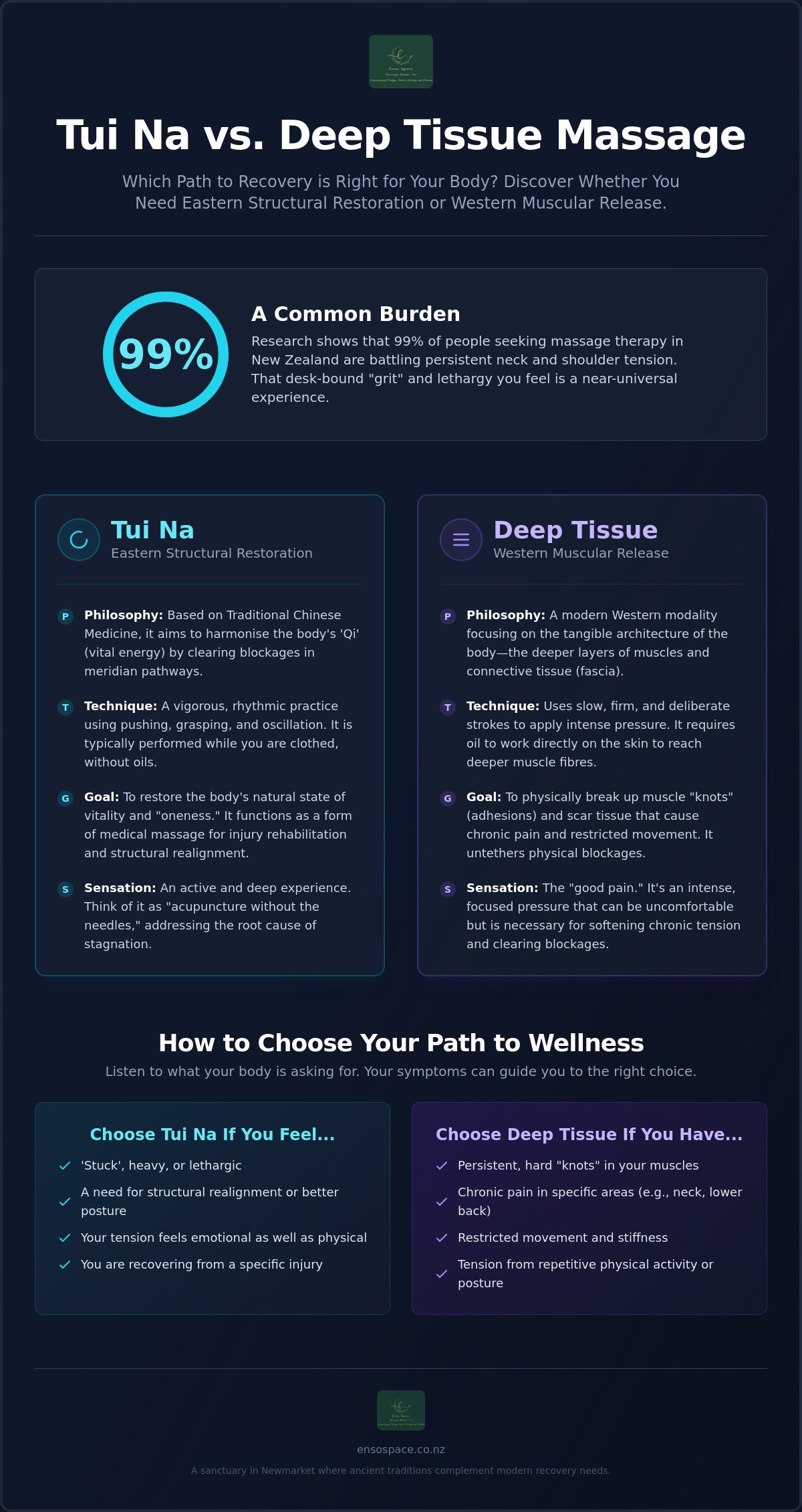
Choice. Clarity. Equilibrium. When deciding between Tui Na vs Deep Tissue massage, the right path depends on the specific language your body is speaking today. In the heart of Newmarket, we see many guests arrive with the weight of Auckland's fast-paced lifestyle on their shoulders, seeking a return to centre without knowing which modality will serve them best. While both treatments offer deep relief, their textures and intentions create very different experiences. One moves like a rhythmic wave; the other moves like a slow, steady tide.
To help you find your middle ground, consider these fundamental differences in the experience:
- The Vibe: Tui Na is rhythmic and energetic, often involving oscillation and movement to stir the Qi. Deep Tissue is slow and focused, utilising sustained pressure to reach the muscle's core.
- The Attire: Traditional Tui Na is typically performed over loose, comfortable clothing without the use of oils. Deep Tissue is performed directly on the skin with oils to allow for long, gliding strokes.
- The Goal: Tui Na seeks energy balance and structural alignment across the meridian highway. Deep Tissue focuses on physical muscle fibre repair and the release of chronic adhesions.
If you feel "stagnant," heavy, or mentally lethargic, Tui Na is your invitation to move. If you feel "sore," physically knotted, or tight from a heavy gym session, Deep Tissue is your path to release. Both are essential tools for those who wish to live better and move better in a busy world.
Which One Should You Choose?
Stillness begins with understanding your needs. Ask yourself: Is my pain sharp and localised, or is it a general sense of being "stuck"? Do I prefer to stay clothed during a session, or do I find oil-based work more restorative? For a truly comprehensive Traditional Chinese Wellness Auckland experience, many of our guests find the "Middle Path" most effective. This involves alternating between the two modalities to ensure both the energetic and physical foundations of the body are honoured. It is the ultimate recovery strategy for long-term health.
The Role of Acupressure in Both Modalities
At Enso Space, our therapists don't believe in a one-size-fits-all treatment. Even during a Deep Tissue session, a wise practitioner may incorporate acupressure points to help settle the nervous system or encourage blood flow to a stubborn knot. This cross-pollination of Eastern and Western techniques ensures a holistic approach that treats the individual, not just the symptom. By bridging these two worlds, we create a sanctuary where every touch is intentional and every movement serves your journey toward oneness. To experience this harmony for yourself, we invite you to book your restorative session and find your point of origin.
Choosing Your Path to Wellness at Enso Space Newmarket
Quietude. Sanctuary. Breath. Stepping off the vibrant bustle of Remuera Road and into Enso Space is an act of intentionality. You leave the noise of Newmarket behind and enter a world designed for restorative harmony. When navigating the choice of Tui Na vs Deep Tissue massage, you aren't just selecting a technique; you're choosing a partner in your long-term wellness. We act as a bridge between ancient tradition and modern recovery, ensuring your journey is both professional and deeply personal.
Consistency is the foundation of true health. For those who wish to make wellness a permanent part of their lifestyle, our Annual Wellness Membership for NZD 200 provides priority and exceptional value. It's an invitation to return to your centre regularly, allowing you to Feel Better, Move Better, and Live Better. By choosing a path of intentional care, you ensure that the stresses of Auckland life don't become permanent fixtures in your body.
The Enso Experience: Beyond the Massage Table
Healing doesn't end when you rise from the table. At Enso Space, we believe the transition back to the world is just as vital as the treatment itself. Every session concludes with a traditional tea ceremony, a meditative practice that grounds the body and settles the spirit. This moment of stillness allows the benefits of your therapy to integrate fully. Our environment is prioritised for its serenity and authenticity; every detail, from the cleanliness of the linens to the scent of the oils, is curated to foster a sense of oneness between body and mind.
Your First Visit to Enso Space
Your journey begins with a conversation. During your initial consultation, we listen to the stories your body tells. You don't need to be an expert in Eastern philosophy or Western anatomy to find relief. Our therapists act as wise guides, helping you decide whether your current state requires the structural restoration of Tui Na or the focused muscular release of Deep Tissue. We meet you exactly where you are, providing a tailored approach that respects your unique needs on the day. To begin your transformation and rediscover your point of origin, book your recovery session at Enso Space today.
Reclaiming Your Natural State of Flow
Balance. Restoration. Home. Your body holds the wisdom of its own recovery; you simply need to provide the right environment for it to begin. Just as Robert Caicedo Real Estate provides expert representation for finding a literal residential sanctuary, choosing the right therapy is a step toward your internal point of origin. Understanding the nuances of Tui Na vs Deep Tissue massage allows you to listen more closely to what your physical and emotional self requires in this moment.
At Enso Space, our premium Newmarket sanctuary offers more than just a treatment. It's a bridge to a more aligned version of yourself. With our authentic TCM expertise and the consistent care offered through our Annual Membership, you can prioritise your health with quiet confidence. We invite you to experience the balance of Tui Na and Deep Tissue at Enso Space and rediscover the ease of movement. Your path to living better is waiting. Trust the process. Find your centre.
Frequently Asked Questions
Is Tui Na massage painful compared to Deep Tissue?
Both treatments involve a level of intensity, but the sensation of Tui Na vs Deep Tissue massage differs in its delivery. Tui Na uses rhythmic oscillation and compression that can feel vigorous and energetic. Deep Tissue relies on slow, sustained pressure to reach the muscle's core. While you might feel a "good pain" in both as blockages release, neither should be unbearable. Our therapists work within your comfort levels to ensure the experience remains restorative.
Do I need to undress for a Tui Na massage at Enso Space?
You typically remain clothed for a Tui Na session at our sanctuary. This ancient practice is traditionally performed over loose, comfortable attire without the use of oils. When considering Tui Na vs Deep Tissue massage, your preference for clothing is a practical factor. Deep Tissue work is performed directly on the skin with oils to allow for the gliding strokes necessary to release muscle adhesions. If you prefer to stay covered, Tui Na is an excellent choice.
Can Tui Na help with chronic lower back pain?
Tui Na is specifically designed to address structural issues like chronic lower back pain. It goes beyond the superficial muscles to realign the body's energetic and physical foundations. By clearing blockages along the meridian pathways and focusing on joint mobility, it helps resolve the root causes of stiffness. It is a powerful clinical tool for those who spend long hours at a desk and require more than just temporary relaxation.
How often should I get a Deep Tissue massage for muscle recovery?
For active individuals, a Deep Tissue session every two to four weeks is often ideal for maintaining muscle health. This frequency allows your therapist to address new adhesions before they become chronic blockages. If you're training for a specific event or recovering from an injury, more frequent visits might be beneficial. Regularity ensures your body remains fluid and resilient against the demands of a modern lifestyle.
What is the difference between Tui Na and Acupressure?
Tui Na is a comprehensive system of manual therapy, while Acupressure is a specific technique used within that system. Think of Tui Na as the whole garden and Acupressure as one of the essential flowers. While Tui Na involves kneading, rolling, and stretching to move Qi, Acupressure focuses solely on applying static pressure to specific meridian points. Both aim to restore your internal flow and foster a sense of oneness.
Is Tui Na suitable for athletes or just for relaxation?
Tui Na is highly suitable for athletes and is frequently used as a clinical tool for injury rehabilitation. While it provides deep relaxation, its primary focus is on structural restoration and improving range of motion. Many athletes use it to enhance performance and speed up recovery times after intense training. It is far more than a relaxation rub; it is a disciplined approach to maintaining physical excellence and structural integrity.
How much does a professional Tui Na therapy session cost in Auckland?
Pricing for therapeutic sessions in Auckland can vary based on the practitioner's expertise and the length of the treatment. Rather than looking for the lowest price, we encourage guests to consider the value of a holistic environment and authentic expertise. You can find our current rates and membership options on our booking page. This ensures you receive the most accurate and up to date information for your wellness journey.
What should I do after my massage to ensure the best results?
Hydration is the most important step after any restorative treatment. Drinking plenty of water helps your system flush away the metabolic waste released from your tissues during the session. We also suggest gentle movement and avoiding intense exercise for at least twenty four hours. This allows your body to integrate the changes and maintain the sense of tranquility achieved during your time in our Newmarket sanctuary.


