
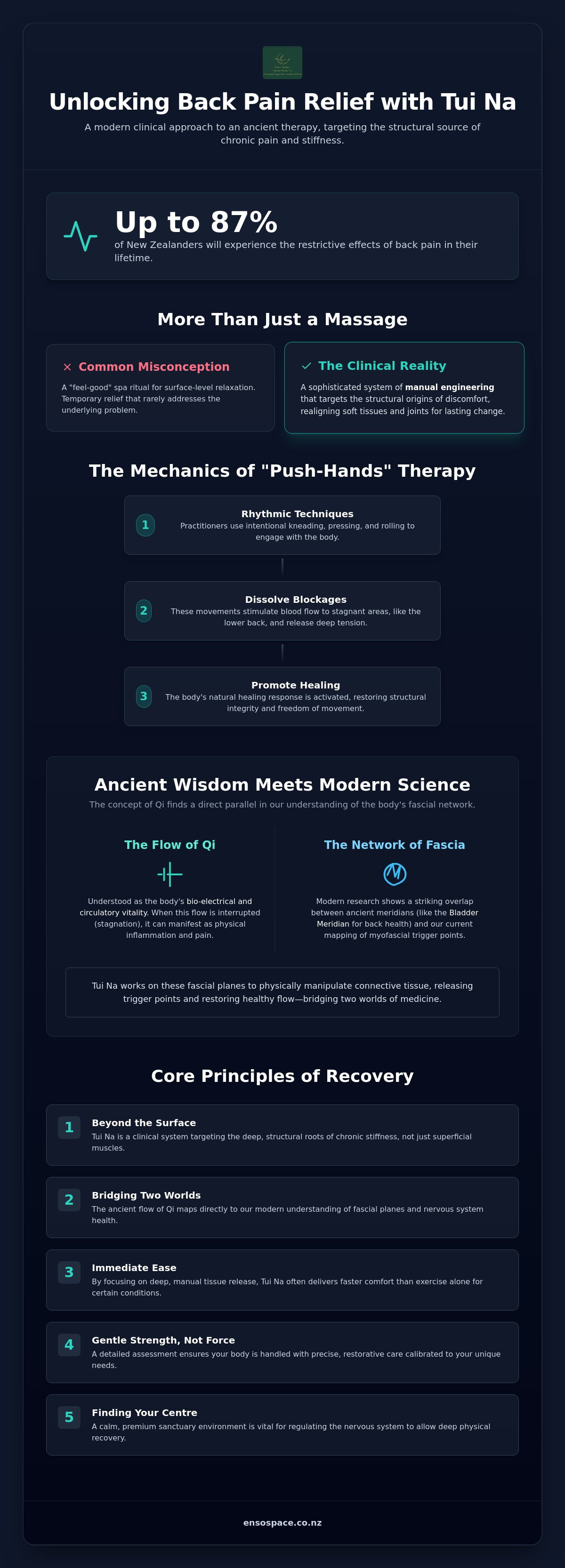
Up to 87% of New Zealanders will feel the heavy, restrictive pull of back pain at some point in their lives. Stillness. Stiffness. The quiet frustration of a body that feels like a cage after a long day at the office. You've likely grown tired of the temporary fixes that vanish before you've even reached the carpark, yet the thought of invasive medical procedures feels daunting. It's a difficult cycle to break. Choosing Tui na for back pain relief offers a more grounded approach, treating your physical form as a connected landscape rather than a collection of isolated aches.
Discover the truth about this ancient Chinese therapy and how it provides genuine, structural relief to help you reclaim your rhythm. This article explores how Tui Na works as a sophisticated system of manual engineering to restore long-term mobility and calm the nervous system. We'll debunk five common myths, explain the importance of registered practitioners in New Zealand, and show you how to reduce your reliance on pain medication. It's time to transition from simple recovery to a state of lasting, restorative harmony.
Key Takeaways
- Beyond the surface. Tui Na is a sophisticated clinical system of rhythmic compression that targets the structural roots of your chronic stiffness.
- Bridging two worlds. See how the ancient flow of Qi maps directly to our modern understanding of fascial planes and nervous system health.
- Immediate ease. Explore why Tui na for back pain relief often delivers faster comfort than exercise alone by focusing on deep, manual tissue release.
- Gentle strength. Learn how a detailed assessment ensures your body is handled with precise, restorative care rather than aggressive force.
- Finding your centre. Understand why a premium sanctuary environment in Newmarket is vital for regulating your nervous system during physical recovery.
Understanding Tui Na for Back Pain Relief: More Than Just a Massage
Precision. Purpose. A foundation for structural change. Many people mistakenly believe that Tui Na is merely a "feel-good" spa ritual designed for surface-level relaxation. This is a common misunderstanding. While the experience is deeply tranquil, Tui na for back pain relief is actually a sophisticated clinical system of manual engineering. It focuses on the "Feel Better" pillar of holistic health by targeting the deep-seated muscle tension that often hides beneath the surface. Instead of simple rubbing, this therapy works to realign soft tissues and joints, addressing the structural origin of your discomfort. It is a method of restoring the body's natural architecture, ensuring that every muscle and tendon finds its rightful place.
The Mechanics of "Push-Hands" Therapy
The art of Tui Na involves a rhythmic dialogue between the practitioner's hands and the patient's body. Techniques like kneading, pressing, and rolling are applied with intentional force to dissolve blockages. These movements create a specific oscillation that stimulates blood flow to stagnant areas of the lower back, encouraging the body's natural healing response. Tui Na is a non-invasive manual therapy used for over 2,000 years to treat musculoskeletal disorders. By Understanding Tui Na as a bridge between physical manipulation and energetic balance, we can see why it remains a cornerstone of recovery. It's a disciplined practice that restores the natural flow of your internal landscape. Each stroke is a calculated effort to move beyond the skin, reaching into the fascia to promote lasting change. This embodies the "Move Better" philosophy, where structural integrity leads to genuine freedom of movement.
Why Sensation Matters in Recovery
Recovery is rarely a silent process. Within our Newmarket sanctuary, we help you distinguish between the "good pain" of a productive release and the "bad pain" of an injury. As a practitioner applies pressure, your nervous system begins to "re-map" areas of chronic tension that your brain may have ignored or guarded for years. This rhythmic movement invites the body to let go of its defensive posture. The practitioner acts as a wise guide, reading the subtle resistance in your muscles to ensure every "push" is calibrated to your unique needs. This intentional approach allows for a profound sense of oneness, where physical recovery meets emotional peace. It's about listening to the body’s whispers before they become screams, creating a space where you can finally breathe into the areas that have been held tight for too long. By engaging with these sensations, you participate in your own restoration, moving from a state of restriction to one of fluid, effortless motion.
The Energy Flow Debate: Is Qi Just a Myth for Modern Pain?
Flow. Movement. Vitality. For many, the concept of "Qi" feels like a poetic abstraction, a relic of a time before we could map every nerve and vessel. This leads to the common myth that meridians are merely mystical constructs with no physical reality. However, when we apply Tui na for back pain relief, we are working with a very real biological bridge. Qi can be understood as the body’s bio-electrical and circulatory vitality. It is the invisible current that ensures nutrients reach your tissues and waste products are carried away. When this flow is interrupted, the result is stagnation. In your back, this often manifests as physical inflammation, a localised heat that signals the body is stuck in a state of perpetual repair without resolution.
This is where the "Move Better" pillar of our philosophy becomes essential. By restoring the natural flow of this vitality, we allow the body to transition from a state of guarded tension to one of fluid grace. It's not about chasing ghosts; it's about facilitating the internal movement that is required for external mobility. If you are curious about how this ancient wisdom translates into a modern clinical setting, you might explore our sanctuary in Newmarket to experience this balance firsthand.
Meridians and Fascia: The Modern Connection
The convergence of East and West is most visible in the study of fascia. Tui Na specifically targets the Bladder Meridian, which is the primary channel for back health, running parallel to the spine from the crown to the feet. Modern research suggests a striking overlap between traditional acupressure points and myofascial trigger points. When a practitioner applies pressure to these points, they aren't just unblocking energy. They are physically manipulating the connective tissue and sending signals to the autonomic nervous system. This manual stimulation encourages the body to switch from a sympathetic "fight or flight" state into a parasympathetic state of rest and repair, allowing the muscles of the lower back to finally soften.
Restoring the Inner Flow
Chronic back pain often feels heavy and immovable. It is "stuck." Tui na for back pain relief breaks this cycle by introducing rhythmic movement that the body can no longer ignore. Beyond the physical release, there is a profound psychological benefit to meridian balance. Pain and stress exist in a feedback loop; the more you hurt, the more your body tenses, and the more you tense, the more you hurt. By addressing the energetic flow, we break this loop. This creates a holistic sense of calm that radiates from the spine outward, helping the mind and body find a shared point of origin where recovery can truly begin.
Tui Na vs. Physiotherapy: Busting the "One-Size-Fits-All" Recovery Myth
Choice. Conflict. A false divide. Many Australians feel forced to pick a side between the clinical logic of Western physiotherapy and the traditional wisdom of Eastern manual therapy. This is a common myth that limits your path to recovery. In reality, these two disciplines don't compete; they converge. For those looking to see how Western clinical expertise can support musculoskeletal health, check out The Orthopaedic & Sports Medicine Institute for insights into specialised orthopaedic care. Choosing Tui na for back pain relief provides a necessary foundation for long-term health, acting as the bridge that links immediate comfort with future strength. By using manual techniques to release acute tension, we prepare the body to engage more effectively with the corrective movements often prescribed in Western models. It's about creating a fertile ground where healing can take root.
Short-Term Relief and Long-Term Mobility
Evidence matters. A study by Singapore General Hospital (SGH) demonstrated that Tui Na is as effective as conventional physiotherapy for managing acute back pain episodes. For those experiencing a "stuck" back, the rhythmic pressure of Tui Na offers faster immediate reduction in pain than exercise alone. It acts as a gentle reset for the muscular system, allowing for a quicker return to daily activities. To truly "Live Better," we recommend an integrated approach:
- The Release: Use Tui Na to dissolve the initial "stuck" sensation and lower localised inflammation.
- The Realignment: Address the structural imbalances through targeted meridian work.
- The Integration: Combine manual therapy with gentle movement to ensure the relief lasts.
The Sanctuary Advantage
Environment is medicine. A clinical cubicle can often heighten the body's defensive response, as the bright lights and sterile atmosphere of a standard clinic may keep your cortisol levels elevated. In our Newmarket sanctuary, we prioritise the emotional peace of the individual. High cortisol levels are known to trigger and sustain muscle spasms; therefore, regulating the nervous system is a vital part of physical recovery. By inviting you into a space designed for stillness, we help your body transition out of a "fight or flight" state. This is the Enso Space difference. We offer a holistic alternative where your recovery is a journey of sensory discovery rather than a series of sterile appointments. Moving beyond the clinical, we provide a space where you can finally let go of the weight you've been carrying in your lower back.
What to Expect: Debunking the Fear of Discomfort
Trust. Safety. A gentle invitation to release. A recurring concern for those seeking Tui na for back pain relief is the fear that the technique might be too aggressive for a sensitive or "bad" back. This is a myth that we wish to gently dissolve. Tui Na is not a blunt force; it is a highly calibrated dialogue between the practitioner and your unique physical state. Before a single hand is placed upon you, we conduct a thorough assessment to understand your specific pain profile. We don't just treat a symptom; we listen to the story your body is telling through its resistance and its rhythm. It is a process of unfolding rather than forcing, ensuring you feel secure at every stage of the recovery.
Your First Session in Newmarket
Your journey begins in the quietude of our sanctuary, far from the frantic pace of the Auckland CBD. The experience is designed to slow you down, moving from the tangible physical tension to a deeper state of internal ease.
- Step 1: Consultation and meridian assessment. We map the landscape of your body to find where your vitality has become stagnant. This isn't just about the lower back; we look at the whole of your being to find the origin of the imbalance.
- Step 2: The Treatment. We begin with gentle meridian warming to prepare the tissues. We slowly invite the muscles to let go of their defensive posture before moving into more targeted pressure, working through layers of tension with patience and precision.
- Step 3: Integration. After the physical work is complete, we transition to a traditional tea ceremony. This is a vital moment of stillness that allows the body to process the structural changes and settle into a state of restorative harmony.
This ceremony bridges the gap between the treatment table and the outside world. To begin your own path to recovery, you can book your initial consultation at our Newmarket sanctuary.
Managing Post-Treatment Sensations
Transition. Renewal. A shift in state. Following a deep meridian release, it's natural to experience what some call "massage flu" or a mild sense of fatigue as your system recalibrates. Mild soreness is a sign of the body’s inflammatory response shifting toward healing. This is not an injury, but rather the sound of your foundations being reset. It's the body's way of clearing the old to make room for the new.
To support this renewal, hydration is vital. Water helps to flush the metabolic waste released during your Tui na for back pain relief session, ensuring your internal flow remains clear. In the 24 hours following your treatment, we generally recommend gentle heat rather than ice. Heat encourages the continued flow of Qi and blood, whereas ice can cause the tissues to contract and stagnate once more. Allow yourself the grace of a slow evening. Rest. Let the silence of the session echo through your home as your body finds its new centre.
Finding Balance: Why Enso Space is Your Auckland Back Pain Sanctuary
Presence. Authenticity. A sanctuary in the city. A final myth persists that all Chinese massages in Auckland offer the same experience. This overlooks the profound difference between a superficial treatment and a dedicated meridian practice. At Enso Space, we bridge the gap between ancient clinical techniques and the modern need for restorative stillness. Choosing Tui na for back pain relief here is not just a transaction; it's an invitation to enter a space where your structural health is handled with the reverence it deserves. We combine the precision of "Push-Hands" therapy with a premium environment that allows your nervous system to fully descend into a state of repair. The experience extends beyond the physical manipulation of muscle and bone. While the manual work addresses the "Move Better" pillar of our philosophy, our traditional tea ceremony completes the journey. This ritual is essential for a total nervous system reset, providing a quiet bridge back to your daily life. It ensures that the calm you find on the table stays with you as you step back into the world.
A Holistic Haven in the Heart of Newmarket
The Path to Consistent Recovery
Maintenance is the key to longevity. While Tui na for back pain relief provides immediate comfort during acute episodes, its true power lies in consistency. Relying on "emergency-only" visits often means waiting until your body is in a state of crisis. Monthly meridian work allows for the gentle, ongoing regulation of your internal flow, preventing tension from crystallising into chronic pain. To support this journey, we offer a Wellness Membership for our dedicated guests. An annual investment of NZD 200 provides you with priority booking and exclusive pricing, ensuring that your recovery remains a consistent priority rather than an afterthought. It's a way to honour your body's need for balance throughout the entire year, fostering a state of oneness that lasts long after you leave our doors.
Reclaim Your Rhythm and Structural Peace
Your journey toward a more resilient back begins with a single, intentional choice. By dissolving the myths surrounding this ancient practice, you've discovered that Tui Na is a sophisticated system of manual engineering designed to restore your body's natural architecture. It is the bridge between ancient wisdom and modern recovery. Our expert practitioners in Chinese Meridian therapy are here to guide you through this process, ensuring every movement serves your long-term mobility. Within our premium Newmarket sanctuary, we provide the quietude necessary for your nervous system to fully recalibrate. The inclusion of a traditional tea ceremony with every treatment ensures that your physical release is met with an equal measure of internal peace.
Renewal. Ease. Choosing Tui na for back pain relief is a profound investment in your ability to move better and live with greater ease. It's time to let go of the stiffness that has held you back for too long. We invite you to step into a space where your recovery is the only priority. Your body is ready to find its centre once more.
Begin your journey to a pain-free back—book your Tui Na session at Enso Space today
Frequently Asked Questions
Is Tui Na safe for a herniated or slipped disc?
Safety is our primary foundation. Tui Na is generally safe for herniated discs when performed by a registered practitioner who avoids high-velocity thrusts or aggressive manipulation. We focus on gentle rhythmic compression and oscillation to reduce the protective muscle guarding around the disc. This allows the surrounding tissues to soften, reducing pressure on the nerve and inviting a more restorative state for the spine.
How many sessions of Tui Na do I need for chronic back pain relief?
Consistency builds the path to recovery. While many feel a noticeable shift after a single visit, chronic conditions typically require three to five sessions of Tui na for back pain relief to achieve stable, structural results. After this initial phase of realignment, we often recommend monthly maintenance. This ensures your internal flow remains clear and prevents the deep-seated stiffness from returning to your lower back.
Will I need to undress for a Tui Na session at Enso Space?
Comfort and modesty are central to the experience. Unlike Western massage styles, Tui Na is traditionally performed through loose, comfortable clothing or a light cotton sheet. You don't need to undress for your treatment. This approach allows our practitioners to perform a greater range of rhythmic rolling and stretching techniques while ensuring you feel completely secure and still throughout the session.
Can Tui Na help with sciatica symptoms?
Relief is found through targeted flow. Tui Na is highly effective for sciatica because it addresses the Bladder and Gallbladder meridians that run along the path of the sciatic nerve. By releasing tension in the piriformis and lumbar muscles, we reduce the physical compression on the nerve itself. This helps to dissolve the radiating pain and restores a sense of fluid oneness to your lower body.
What is the difference between Tui Na and a standard Deep Tissue massage?
Theory defines the depth of the work. A standard deep tissue massage focuses primarily on the anatomical layers of muscle and fascia to release tension. Tui Na is a clinical system based on meridian theory and the movement of Qi. It uses specific techniques like "push-hands" and rhythmic oscillation to harmonise your internal vitality while simultaneously addressing the structural alignment of your spine and joints.
Is Tui Na recommended for lower back pain during pregnancy?
Gentle support is available for expecting mothers. Tui Na is a safe and supportive therapy for pregnancy-related back pain when performed by a qualified professional who understands the necessary precautions. We avoid specific acupressure points that are contraindicated during pregnancy. Instead, we focus on the areas of the hips and lower back that carry the most weight, providing a peaceful sanctuary for your body to rest.
How long does the pain relief from one session typically last?
Lasting change is a cumulative process. The immediate relief from a single session of Tui na for back pain relief can last from several days to a week as your nervous system recalibrates. However, as you continue with a regular rhythm of treatments, your body "learns" to hold less defensive tension. This leads to improved long-term mobility that can last for weeks or even months between your visits to our sanctuary.
Do I need a referral to book a Tui Na treatment in Auckland?
Access to holistic care is straightforward. You don't need a GP referral to book a Tui Na treatment at our Newmarket sanctuary. We welcome self-referrals from anyone in Auckland seeking a more grounded and traditional approach to their physical recovery. Simply reach out to us to begin your journey toward a more balanced state of existence, where your long-term well-being is our only priority.


