

What if the secret to your next personal best isn't hidden in another heavy set, but in the silent spaces between your muscles? You have pushed through the burn and felt the weight of heavy legs on a Monday morning. For many, Tui Na for athletes Auckland is the missing link between intense training and sustainable power. It is a practice that honours the body's need for stillness to achieve its greatest strength.
We understand the frustration of delayed onset muscle soreness stalling your progress, or that persistent stiffness that follows a long day at the desk before hitting the gym. It's common to feel your range of motion narrowing in the shoulders and hips just when you need it most. This guide explores how traditional Tui Na massage clears physical blockages and accelerates recovery by bridging the gap between Eastern meridian therapy and Western athletic training. You will learn how to reduce injury risk and return to peak performance with a body that feels fluid, grounded, and ready for the next challenge.
Key Takeaways
- Focus. Flow. Learn how Tui Na acts as a dynamic "push-hands" system to clear the internal highways of the body and restore essential energy.
- Discover why the rhythmic, vigorous movements of Tui Na are often more effective for systemic fatigue than the static pressure of traditional deep tissue techniques.
- Optimise your training cycle by integrating Tui Na for athletes Auckland during the critical 48 to 72-hour recovery window for peak muscle release.
- Understand the science of meridian pathways and how clearing energetic blockages directly translates to a reduced risk of injury and improved range of motion.
- Identify the ideal "middle ground" between a clinical setting and a spiritual retreat to support your long-term athletic goals and physical harmony.
Why Tui Na for Athletes Auckland is the Secret to Performance
Auckland is a city of movement. We run the Waitakere trails. We train in CBD gyms. We balance demanding corporate careers with rigorous physical goals. This dual pressure creates a specific kind of fatigue that standard sports massage often fails to reach. For those seeking a deeper edge, Tui Na for athletes Auckland offers a bridge between high-performance output and profound internal restoration. Unlike the passive nature of some therapies, Tui Na is a dynamic, "push-hands" system that treats the body as a functional whole. It doesn't just address the muscle; it addresses the Qi, the vital life force that governs every sprint and every lift. By clearing energetic and physical stagnation, Tui Na facilitates the swift removal of lactic acid from tired muscle fibres.
Traditional Western massage often views the body as a collection of isolated parts. In contrast, this ancient practice looks at the highways of energy that connect your heels to your crown. When choosing Tui Na for athletes Auckland, you are opting for a method that understands the unique load placed on the modern body. Whether that load comes from training or the physical demands of transport and logistics—where cargo safety equipment from CargoCare NZ is essential—proper recovery is the key to longevity. It is a discipline that respects the anatomy of the athlete while honouring the wisdom of the meridians. This dual approach ensures that recovery is not just a temporary relief, but a foundational rebuilding of your physical state.
The Physiological Impact on Sore Muscles
Restoration. Rhythmic. Precise. The physical application of Tui Na involves a series of rolling, pressing, and kneading techniques that do more than just relax the surface. These movements create a rhythmic compression that significantly increases micro-circulation within fatigued tissues, delivering fresh oxygen exactly where it is needed most. By stimulating specific meridian points, the therapy helps to lower inflammation markers that accumulate after intense sessions. It also works deeply into the fascia, releasing the "stuck" sensations in joints that often follow heavy lifting or repetitive endurance work.
Restoring the Parasympathetic Balance
Training is a beautiful stress. However, it often leaves the nervous system trapped in a "fight or flight" response long after the session ends. Tui Na acts as a gentle signal to the body, whispering that the work is done and the healing can begin. It shifts the athlete from a state of high-alert tension into the parasympathetic "rest and digest" mode. This transition is vital for deep tissue repair and mental clarity. In the quiet of our sanctuary, the gap between physical exhaustion and mental stillness finally closes, allowing you to return to your training with a sense of oneness and renewed focus.
Comparing Tui Na and Deep Tissue for Muscle Recovery
Pressure. Release. Stillness. While both modalities aim to restore the body, the path they take is distinct. Deep tissue massage relies on slow, sustained pressure to reach the sub-layers of muscle and the surrounding connective tissue. It is a focused, almost meditative descent into the physical self. Conversely, Tui Na for athletes Auckland is a more vigorous, rhythmic experience. It utilises the "push and grasp" method to invigorate the body's meridians, drawing from the ancient foundations of Traditional Chinese Medicine. Choosing between them often depends on whether your body requires the unravelling of a specific knot or the clearing of systemic fatigue.
If you're struggling with a specific "knot" that won't let go, deep tissue is often the preferred choice. It targets the physical adhesion directly with static force. However, when you feel a heavy, pervasive exhaustion after a high-volume training block, Tui Na is often superior. It doesn't just press; it moves. It encourages the flow of energy and blood, ensuring that no part of the system remains stagnant. For a deeper dive into these differences, you can explore our guide on Tui Na vs Deep Tissue massage to see which path your body needs today.
When to Choose Deep Tissue in Newmarket
Foundation. Alignment. Stability. At our Remuera Road centre, we often recommend deep tissue for athletes dealing with chronic adhesions born from repetitive motions, such as the rhythmic strike of running or the sustained posture of cycling. This technique focuses on realigning the deeper layers of musculature. It is a structural approach that ensures your physical foundation remains solid, allowing you to move with greater efficiency during your next session. By sinking into the sub-layers of the muscle, we help resolve the persistent tension that can hinder your range of motion.
When Tui Na is the Superior Recovery Tool
Flow. Vitality. Lightness. Tui Na for athletes Auckland excels when the primary goal is to shed the sensation of "heavy legs" or acute stiffness. Using rhythmic "grasping and rolling" techniques, our therapists stimulate circulation without the need for excessive, painful pressure. It is particularly effective for those seeking Tui Na for back pain relief, as it addresses the energetic blockages that often manifest as lower back tension after intense training. If you are ready to find your centre again, our Newmarket wellness sanctuary provides the perfect space to begin your recovery journey. Combining these two approaches offers a unique form of structural stability, ensuring you don't just recover, but truly thrive.
The Science of Meridian Flow in Athletic Performance
Pathways. Rivers. Highways. Within the body exists a complex network of meridians, the internal channels that transport energy and vital nutrients to every cell. For the active individual, these pathways are the infrastructure of performance. When we train intensely, we don't just stress our muscle fibres; we place a heavy demand on this energetic flow. Tui Na for athletes Auckland works by ensuring these channels remain open and vibrant. There is growing scientific evidence for Tui Na in sports medicine that suggests these traditional manipulations effectively manage pain and recovery by addressing the body's internal systems.
Stagnation is the enemy of the athlete. When Qi, or vital energy, becomes trapped due to overexertion, it manifests as the dull ache of delayed onset muscle soreness (DOMS) or a sharp, restrictive pain. This energetic traffic jam prevents metabolic waste from clearing and stops fresh nutrients from reaching the site of repair. By viewing recovery through this lens, Chinese Meridian Massage Auckland becomes more than a luxury. It is an essential maintenance tool that restores the internal highways, allowing your body to heal with the same intensity that you train.
Key Acupressure Points for Leg and Core Recovery
Precision. Focus. During a session, we target specific points to unlock physical potential. For example, Gallbladder 34 (GB34), located on the outer side of the lower leg, is known as the "influential point of tendons". Stimulating this point supports tendon and ligament health, which is crucial for those in high-impact sports. We also focus on Stomach 36 (ST36) to boost overall endurance and accelerate energy recovery. This precision acupressure complements traditional muscle manipulation, ensuring your recovery is both deep and comprehensive.
Preventing Injury Through Energetic Balance
Flow. Balance. Resilience. True athletic longevity comes from moving beyond "fixing" problems to maintaining a state of constant flow. Meridian care allows us to identify subtle energetic imbalances before they manifest as physical injuries. It's about listening to the body's quietest signals. By embracing the philosophy to "Feel Better, Move Better, Live Better", Auckland athletes can achieve a state of internal harmony that supports their external ambitions. Tui Na for athletes Auckland provides the necessary bridge to this state of readiness, ensuring your training remains consistent, powerful, and free from the setbacks of avoidable strain. For men looking to further optimise their physical performance and vitality, it can also be beneficial to explore SONICWAVE Therapy as part of a comprehensive approach to health.
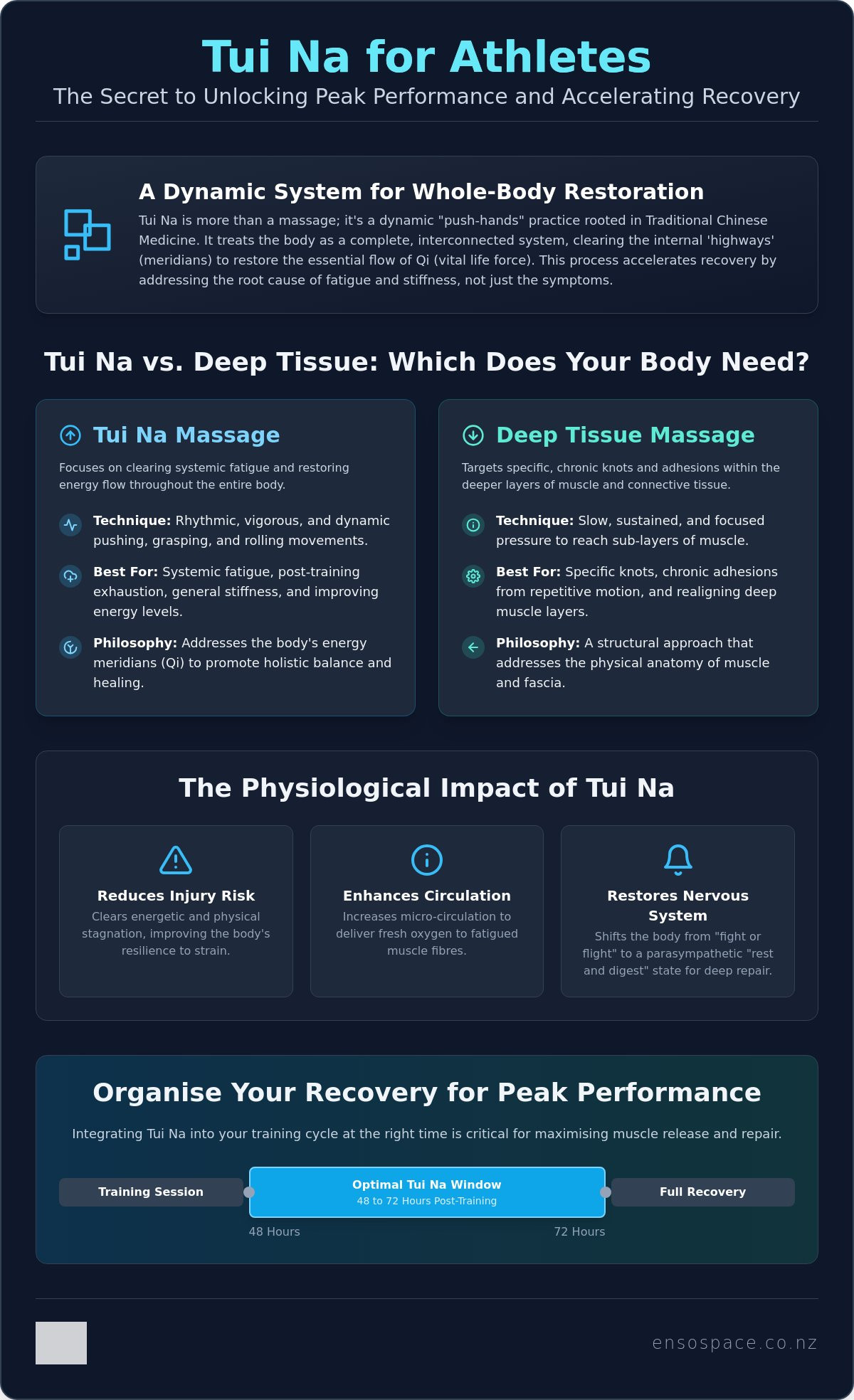
How to Organise Your Recovery Schedule for Peak Performance
Rhythm. Timing. Balance. To achieve peak performance, your recovery must be as structured as your training. For those utilising Tui Na for athletes Auckland, timing is the difference between simple relief and profound restoration. We recommend the 24-Hour Rule for immediate post-event care. Within this window, the body is often too sensitive for intense manipulation; instead, we focus on gentle Tui Na or lymphatic work to encourage the movement of fluids and reduce swelling. This approach honours the body's immediate inflammatory response while softly initiating the healing process.
The Deep Work Window opens between 48 and 72 hours after your hardest session. This is the ideal time for more vigorous Tui Na for athletes Auckland, as the initial acute soreness has subsided, allowing our therapists to reach the deeper layers of muscle and fascia. For those in high-volume training phases, weekly sessions are essential to prevent the accumulation of stagnation. If you are in a maintenance phase, a fortnightly visit provides the necessary check-in to ensure your meridians remain clear. You can find more about these foundational principles in our guide to Traditional Chinese Wellness Auckland.
Your Post-Training Recovery Ritual
Preparation is a form of respect. Before your session, focus on hydration and light active stretching to prime the fascia for movement. During the treatment, use deep, rhythmic breathwork to signal your nervous system to let go. This allows for a much deeper tissue release without resistance. Once the physical work is complete, we invite you to participate in our tea ceremony. This ritual is not just about rehydration; it is a vital moment of grounding that helps integrate the physical changes back into your daily life.
Leveraging the Wellness Membership for Consistency
Resilience. Growth. Oneness. Consistency is the soil in which performance grows. Our NZD 200 Annual Wellness Membership is designed for the dedicated athlete who understands that regular sessions build long-term physical durability. By committing to a programme, you ensure your recovery isn't just a reaction to pain, but a proactive strategy for excellence. This is especially important when organising your year around major Auckland sporting events, such as the Auckland Marathon or local cycling series. To secure your place in our recovery schedule, you can book your session at our Newmarket sanctuary and begin your journey toward a more balanced physical state.
Enso Space: Auckland’s Premium Sanctuary for Athlete Recovery
Stillness. Sanctuary. Strength. Located at 17 Remuera Road, our Newmarket space is designed as a secluded retreat from the relentless pace of Auckland life. It is here that we offer the "middle ground" between a clinical physiotherapy environment and a spiritual retreat. We believe that for an athlete to truly heal, the environment must be as intentional as the therapy itself. Our sanctuary is a place of absolute calm, where cleanliness and sustainability meet a refined, meditative aesthetic. It is a space where you can finally slow down, allowing the body to redirect its energy toward deep repair and restorative harmony.
For athletes looking to bring this sense of retreat into their own gardens, specialists like Simply Saunas offer premium solutions for building a personal wellness sanctuary dedicated to heat therapy and restorative rest.
The expertise of our therapists lies in their ability to bridge the gap between ancient Eastern wisdom and modern Western anatomy. They understand the mechanics of a squat and the tension of a sprint, yet they also see the invisible pathways of the meridians that govern your vitality. By choosing Tui Na for athletes Auckland at Enso Space, you are placing your recovery in the hands of professionals who value "oneness" and connection. We don't just treat symptoms; we work to restore your entire physical and energetic foundation, ensuring you leave feeling more grounded than when you arrived.
A Tailored Approach for Every Sport
Every body tells a different story. Whether you are a runner navigating the hills of the Domain, a weightlifter pushing limits in a local box, or a corporate athlete balancing high-stress deadlines with gym sessions, your Tui Na for athletes Auckland experience is customised to your specific load. We focus on providing authentic, professional care in the heart of Newmarket. Our goal is simple and profound. We want every guest to feel better and move better, ensuring that your physical state supports your lifestyle rather than hindering it.
The Final Sip: Why the Tea Ceremony Matters
The transition is vital. After the deep physical work of a Tui Na session, we invite you to participate in a traditional tea ceremony. This is not merely a drink; it is a mindful bridge back to the busy Auckland rhythm. Warm tea supports digestion and encourages the continued flow of energy that was initiated during your treatment. It provides a final moment of mental stillness before you step back into the world. If you are ready to experience this unique blend of professional therapy and traditional culture, we invite you to book a recovery session at Enso Space today and discover the path to your peak performance.
Step Into Your Next Personal Best
Stillness. Balance. Power. True athletic excellence is not just found in the intensity of your training, but in the quality of your rest. By integrating Tui Na for athletes Auckland into your routine, you choose a path that honours both the physical muscle and the internal meridian flow. You have learned how this dynamic therapy clears stagnation, how the 48 to 72-hour window is your prime recovery zone, and why a structured programme builds lasting resilience. Recovery is the foundation upon which your next victory is built.
We invite you to our Newmarket sanctuary to experience the middle ground between clinical repair and total serenity. Our expert therapists specialise in Tui Na and Meridian flow, ensuring your body returns to its natural state of oneness. Every session concludes with a holistic tea ceremony, designed to ground your energy and prepare you for the world outside. It's time to move better and live better. Book your athlete recovery session at Enso Space Newmarket and discover the restorative harmony your body deserves. Your peak performance is waiting.
Frequently Asked Questions
How soon after a heavy gym session should I book Tui Na in Auckland?
Ideally, you should wait 48 to 72 hours before booking deep Tui Na for athletes Auckland. This window allows the initial acute muscle inflammation to subside, ensuring the treatment is both comfortable and effective. If you require immediate care within the first 24 hours, we focus on gentle meridian work and lymphatic drainage to softly encourage the removal of metabolic waste.
Will Tui Na be too painful if I have severe muscle soreness?
No, the experience should never be distressing. While the "push-hands" techniques are vigorous and rhythmic, our therapists always adjust the pressure to respect your body's current state. We use your breath as a guide to navigate areas of tension. The goal is to invite the muscle to release and let go, fostering a sense of restorative harmony rather than adding further stress to the tissue.
What is the main difference between sports massage and Tui Na for athletes?
Sports massage generally focuses on the mechanical manipulation of isolated muscle groups and fascia to improve blood flow. Tui Na for athletes Auckland takes a more holistic approach by integrating the meridian system. It treats the body as a functional whole, clearing energetic blockages and restoring the flow of Qi to ensure that physical recovery is supported by internal balance.
Can Tui Na help prevent common sports injuries like hamstring strains?
Yes, it is an exceptional tool for injury prevention. By maintaining the flow of nutrients through the meridians, Tui Na keeps the tendons and ligaments resilient and supple. Regular sessions allow our expert therapists to identify subtle areas of stagnation or "stuck" fascia. Addressing these minor imbalances early prevents them from developing into acute strains or tears during high-intensity movements.
What should I wear to a Tui Na session at Enso Space Newmarket?
Comfort is essential. We recommend wearing loose, soft clothing to our Newmarket sanctuary. Some traditional techniques can be performed through light fabric, while others may require direct skin contact for the use of therapeutic oils. We always provide professional draping and a secure, serene environment to ensure you feel completely at ease throughout your recovery journey.
How often should a competitive athlete in Auckland get a recovery massage?
Consistency builds resilience. For athletes in the midst of a high-volume training block, we recommend weekly sessions to manage cumulative fatigue and prevent stagnation. If you are in a maintenance phase or tapering for an event, a fortnightly session is usually sufficient to keep the meridians clear and the body in a state of readiness. Beyond personal preparation, event safety is paramount, and many organisers explore Extended roof ambulance on GMC & toyota to provide reliable medical infrastructure for participants.
Do I need to drink extra water after a Tui Na recovery session?
Yes, hydration is a vital part of the process. The rhythmic compressions of Tui Na stimulate the lymphatic system and encourage the release of waste products from the muscles. Drinking extra water helps your system flush these elements away more efficiently. Our tea ceremony provides a mindful starting point for this rehydration, grounding your energy before you return to your day.
Is Tui Na better than stretching for post-workout stiffness?
They are different but complementary. Stretching is excellent for maintaining the length of muscle fibres, but it often cannot reach the deeper energetic blockages or the dense layers of fascia. Tui Na provides a more comprehensive release by stimulating the internal highways of the body. It offers a level of deep, systemic restoration that stretching alone cannot achieve, making it a perfect partner to your mobility routine.


