
Stillness. Flow. Restoration. Your body is a landscape of rivers, but sometimes, the water stops moving. For many professionals in Newmarket, this stagnation manifests as persistent muscular knots or a heavy, sluggish fog that refuses to lift. You've likely felt that stubborn tension in your shoulders that standard treatments can't quite reach. Professional tui na therapy offers a different path. It is a disciplined, ancient practice that addresses both the structural and energetic blockages at their source.
We recognise that feeling of being physically and mentally stuck. It is a disruption of your natural rhythm. This guide promises to show you how this "push-hands" therapy restores your physical flow and mental stillness through expert meridian work. We will preview the technical precision of tui na, its status as a regulated health profession in New Zealand, and how a serene, professional environment can facilitate your total recovery. It's time to stop managing tension and start restoring your centre.
Key Takeaways
- Understand the ancient "push-hands" technique of Tui Na, which uses rhythmic movements to address deep structural and energetic blockages.
- Discover how professional tui na therapy restores your body's internal flow by clearing stagnation along meridian pathways to enhance overall vitality.
- Learn the critical differences between Western deep tissue massage and Tui Na, focusing on how targeting energy flow provides more holistic relief.
- Identify how regular recovery sessions can alleviate the specific postural strains of Newmarket office life, often referred to as the "Auckland Ailment."
- Explore the importance of a serene, professional sanctuary that prepares your mind and body for recovery before the physical therapy even begins.
What is Professional Tui Na Therapy? The Ancient Art of Push-Hands
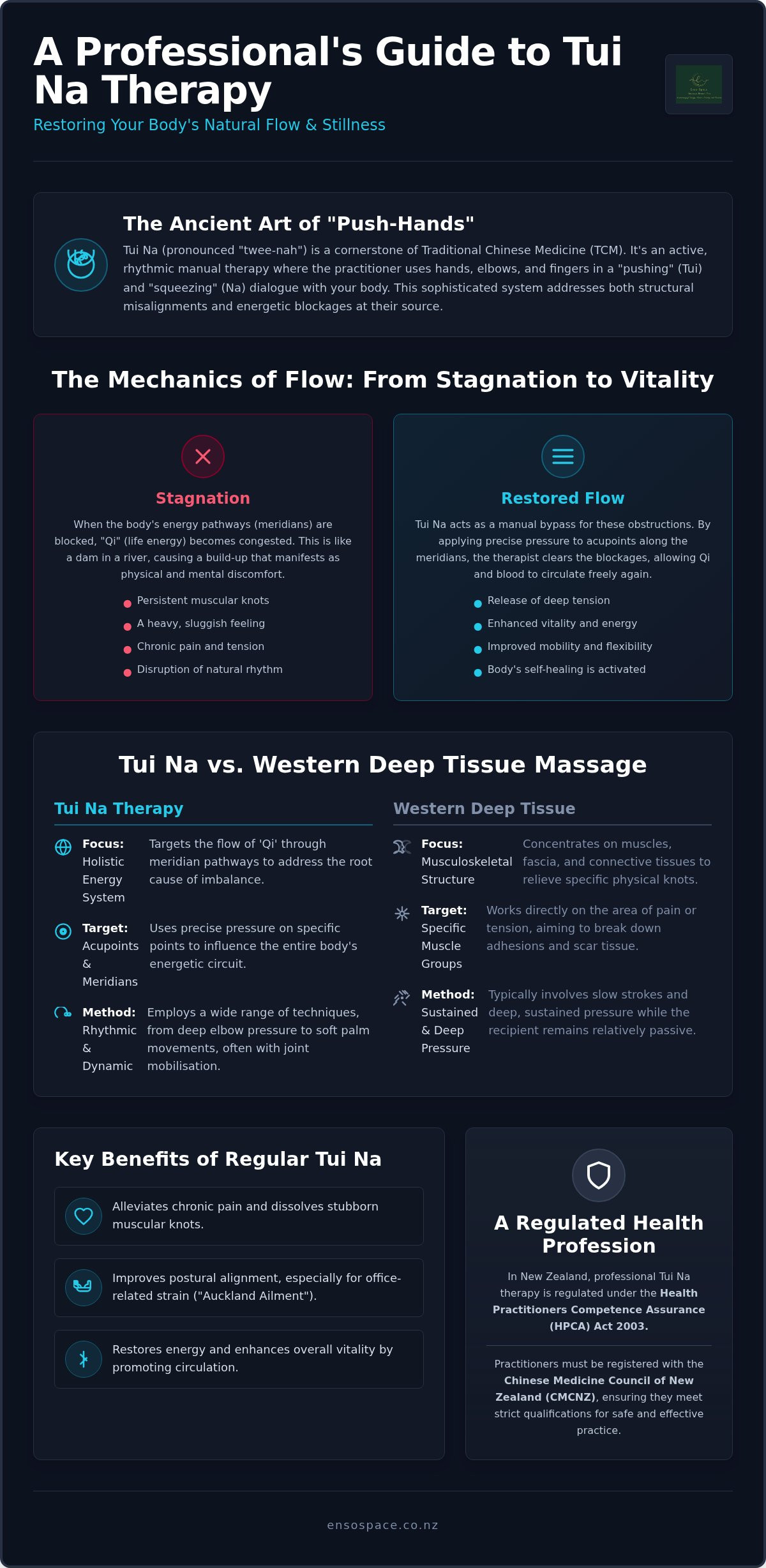
Stillness. Focus. Recovery. Professional tui na therapy is far more than a simple sequence of movements; it is a sophisticated system of manual therapy that has served as a cornerstone of Traditional Chinese Medicine (TCM) for millennia. Alongside acupuncture and herbalism, it forms a triad of healing that addresses the person as a whole. The name itself reveals the method. "Tui" means to push, while "Na" translates to lifting and squeezing. Together, these actions create The Ancient Art of Push-Hands, a practice that restores the body's natural alignment and internal rhythm.
Unlike many passive Western massages where the guest remains relatively still while the therapist works, Tui Na is an active, rhythmic dialogue. It is a communication between the practitioner’s hands and the body’s internal landscape. The therapist uses their palms, fingers, and elbows to create a wave of movement that travels deep into the tissues. This encourages the release of physical knots and energetic blockages, moving beyond the surface to find the source of your discomfort.
The Origins of Tui Na
This practice carries a lineage spanning over 2,000 years of clinical observation and refinement. It was developed to treat a spectrum of concerns, from structural misalignments in the joints to internal imbalances that affect digestion or sleep. While the roots are ancient, modern Tui Na has evolved. It now integrates these time-honoured techniques with a contemporary understanding of biomechanics and anatomy. This fusion ensures that every movement is grounded in both tradition and modern science, providing a bridge between the old world and our current needs.
Why 'Professional' Therapy Matters
True mastery in this field requires more than just physical strength. Professional tui na therapy in New Zealand is a regulated health profession, a status mandated under the Health Practitioners Competence Assurance (HPCA) Act 2003. This regulation ensures that your practitioner is registered with the Chinese Medicine Council of New Zealand (CMCNZ) and holds the necessary qualifications to practice safely.
Mastery also demands an intimate knowledge of the 12 primary meridians, the pathways through which life energy, or "Qi", flows. A skilled practitioner doesn't just feel for muscle tension; they assess "Qi" stagnation through touch. In a premium sanctuary like Enso Space in Newmarket, "professional" also translates to the environment. It means stepping into a clean, expertly managed centre where every detail is designed for your safety and peace. It is about the assurance that your therapist is qualified to interpret the subtle signals your body sends, ensuring a recovery that is as safe as it is profound.
The Mechanics of Flow: How Tui Na Restores Your Body’s Energy
Connection. Unity. Balance. Everything in your body is linked through a delicate, invisible network. When this network is clear, we feel vibrant. When it is blocked, we feel heavy. Professional tui na therapy acts as a manual bypass for these physical and energetic obstructions. By applying specific, rhythmic pressure, the therapist encourages the body to move past its own resistance. Meridians are the body's superhighways for vital energy. When these roads are congested, stagnation occurs. Stagnation leads to pain, but movement leads to vitality. It is the difference between a stagnant pond and a mountain stream.
The practitioner views the body as an integrated whole, where a knot in the shoulder might be the result of a blockage further down the line. By addressing these "kinks" in the system, Tui Na allows for a total reset. Choosing professional tui na therapy means investing in your long-term mobility rather than just seeking a temporary fix. It is not just about the area that hurts; it is about the entire circuit. When the energy flows freely, the body regains its natural ability to heal and maintain itself.
Acupoints and Pressure Techniques
The hands are tools of precision. Practitioners use their fingers, palms, and even elbows to stimulate specific acupoints along the meridian lines. This intentional pressure triggers the body’s natural self-repair mechanisms, sending signals to the nervous system to release and reorganise. These Tui Na massage techniques vary in intensity and intent. We balance "Yang" movements, which are dynamic, deep, and invigorating, with "Yin" techniques that are gentle, passive, and deeply grounding. A deep elbow technique might be used to break down a stubborn knot in the lower back, while a soft palm movement calms the nervous system. This duality ensures that the treatment meets your body exactly where it is. It is a tailored dialogue that speaks to your unique state of being.
Restoring the Internal Foundation
Beneath the skin, a complex architecture of fluid and energy requires constant motion. Tui Na doesn't just rub muscles; it organises the flow of blood and Qi. By clearing the pathways, the therapy supports essential functions like lymphatic drainage and circulatory health. This is the foundation of physical vitality. For those spending long hours in Newmarket offices, this stimulation is vital for reversing the effects of postural strain. As the physical blockages dissolve, many guests report a profound sense of emotional lightness. The burden of the day seems to lift as the body finds its centre again. This holistic approach is why many choose to explore meridian care as a regular part of their recovery ritual in Auckland. Movement leads to vitality, and vitality leads to peace.
Tui Na vs. Deep Tissue Massage: Which Therapy Suits Your Body?
Choice. Discernment. Clarity. When you seek recovery, the intent behind the touch defines the outcome. While both modalities aim to alleviate physical discomfort, they operate on distinct philosophies. Deep tissue massage focuses on the 'what'; it identifies a specific muscular knot and applies direct pressure to release it. Conversely, professional tui na therapy focuses on the 'why.' It observes the flow of energy and blood through the entire body to understand why that knot formed in the first place. This distinction is vital for those deciding between lymphatic drainage vs deep tissue massage or a traditional meridian-based approach.
The sensory experience also differs. Western massage often relies on oils to glide over the skin. Tui Na is different. It can be performed through light, comfortable clothing or with specific herbal balms that target deep stagnation. It is a choice between a purely structural reset and a holistic energy balancing. One addresses the physical frame, while the other organises the life force within it.
When to Choose Tui Na
Stillness is found in motion. This therapy is the ideal choice for those experiencing chronic stiffness, joint mobility issues, or a persistent sense of being 'burnt out.' If you feel your energy has become sluggish, professional tui na therapy provides an active dialogue to restore your internal foundation. It is perfect for individuals seeking a more traditional healing experience that addresses the root cause of tension. It is a rhythmic, restorative journey for those who want to feel their physical and mental flow return in unison.
When to Choose Deep Tissue
Precision. Focus. Physicality. Deep tissue is best suited for specific sports injuries or tension isolated to a single muscle group. It is a clinical approach that prioritises the physical manipulation of the fascia and deep muscle layers. If you have a targeted injury from a specific activity or prefer a familiar, Western-style clinical session, this is a great choice. It provides a direct, structural relief for the physical frame, ensuring that isolated muscle groups receive the concentrated attention they require to release and recover.
The Benefits of Regular Tui Na: From Pain Relief to Postural Alignment
Consistency. Foundation. Wellness. True physical freedom is built through regular attention rather than sporadic intervention. For many professionals in Newmarket, the "Auckland Ailment" is a familiar burden. It is the heavy, persistent tightness in the neck and shoulders that arises from long hours at a desk. This postural strain is a form of physical stagnation that professional tui na therapy is uniquely designed to resolve. By focusing on the meridian pathways, regular sessions prevent minor "stuckness" from hardening into chronic pain. Understanding the Tui Na massage benefits Auckland locals can access is the first step toward prioritising long-term health over temporary fixes.
The body remembers the stress it carries. When we ignore these signals, the tension becomes part of our structure. Regular recovery ensures that the rivers of energy within remain clear and unobstructed. It's about maintaining your centre in a world that constantly pulls you away from it. By choosing a professional approach, you ensure that every session builds upon the last, creating a cumulative effect that transforms your overall sense of well-being.
Stress Recovery for Professionals
Calm. Clarity. Release. Stress is often more than a mental state; it is a physical manifestation that settles deep within the tissues. Professional tui na therapy acts as a bridge to peace by calming the nervous system and releasing the physical "armour" built up during the working week. When the internal flow is restored, the body finds it easier to transition into a state of rest. This balancing of Yin and Yang energies leads to significantly improved sleep quality and a more resilient spirit. Guests frequently experience a sense of renewed mental clarity as the energetic blockages dissolve, allowing for a total system reset.
Enhanced Mobility and Posture
Alignment. Space. Strength. The therapy uses intentional joint rotations and rhythmic stretches to decompress the spine and create a sense of internal room. It is particularly effective at reversing the modern "slump" by opening the meridians across the chest and shoulders that often become constricted. Tui Na supports the goal to Move Better by increasing your functional range of motion through a combination of structural manipulation and meridian clearing. This allows you to carry yourself with a natural, effortless posture that reflects your internal state of balance. If you are ready to reclaim your physical flow, we invite you to secure your professional recovery session at our Newmarket sanctuary.
The Enso Space Experience: Professional Tui Na in a Serene Sanctuary
Peace. Presence. Oneness. At Enso Space, we believe wellness is not a transaction; it's a journey toward a more integrated self. Our Newmarket sanctuary at 17 Remuera Road is designed to slow your breathing before the therapy even begins. The transition from the bustle of the city to our serene environment is intentional. It's a bridge between the external world and your internal state. From the moment you arrive, every detail is organised to foster a sense of safety and quiet confidence.
Professional tui na therapy in our space is a choreographed ritual of recovery. It begins with a professional assessment to understand your unique needs and ends with a deliberate transition back to daily life. For those who view health as a long-term foundation, our Annual Wellness Membership is available for NZD 200. This membership is the ultimate commitment to self-care, allowing you to weave regular restoration into the fabric of your life. It ensures that your path to balance is not a one-off event, but a sustainable practice.
A Holistic Approach to Healing
We offer a sanctuary where ancient wisdom meets modern needs. By combining Tui Na with Chinese Meridian Massage Auckland, we provide a complete reset for both the physical and energetic body. Our practitioners are masters of both technical precision and deep empathy. They understand that every guest carries a different story in their muscles. Our clean, sustainable, and community-oriented environment ensures that your recovery takes place in a space that respects both the individual and the natural world. It's about finding that middle ground where the body can finally let go.
Grounding with a Tea Ceremony
The transition back to the world is as important as the treatment itself. We don't believe in rushing you out the door. Instead, we invite you to integrate the benefits of your session through a traditional tea ceremony. This is a moment of mindful reflection in the heart of Newmarket. As you sip the tea, you allow the newfound flow within your meridians to settle and stabilise. It's a final step in grounding your energy, ensuring you leave our sanctuary feeling not just relaxed, but truly whole. You return to your day with a restored centre and a quiet, renewed strength.
Reclaiming Your Natural Rhythm
Stillness. Flow. Restoration. Professional tui na therapy is more than a physical treatment; it is a return to your origin. We have explored how this ancient "push-hands" method clears the stagnation of the "Auckland Ailment" and restores the vital pathways of your meridians. By choosing a path that addresses the root cause of tension rather than just the symptoms, you allow your body to move and live better. It is a transition from feeling stuck to feeling whole.
At our premium Newmarket sanctuary, every session is a journey toward oneness. Whether you are seeking immediate relief from postural strain or committing to long-term wellness through our NZD 200 Annual Wellness Membership, we provide a space for deep, intentional recovery. Every holistic experience concludes with a traditional tea ceremony to ground your energy before you return to the world. We invite you to Book your Professional Tui Na session at Enso Space today and rediscover your internal foundation. Your path to balance begins with a single, mindful breath.
Frequently Asked Questions
Is professional Tui Na therapy painful for beginners?
Professional tui na therapy isn't meant to be painful, though you might feel a deep, achy sensation as blockages are cleared. We call this "De Qi," a sign that the energy is beginning to flow again. Our practitioners in Newmarket always adjust the pressure to match your comfort level. It is a dialogue between your body and the therapist's hands. You should leave feeling lighter and more spacious, not distressed or bruised.
Do I need to undress for a Tui Na session at Enso Space?
You don't necessarily need to undress for a Tui Na session. This therapy is traditionally performed through light, loose-fitting clothing. If you prefer, we can also work directly on the skin using specific herbal balms or oils, similar to a deep tissue session. At Enso Space, your comfort is our priority. We provide a clean, private environment where you can choose the approach that makes you feel most at ease during your recovery.
How many sessions of Tui Na are needed to see results for back pain?
Many guests feel immediate relief after their first visit, but chronic back pain usually requires a series of sessions to achieve lasting results. We often suggest a foundation of four to six weekly treatments to fully reorganise the meridian flow and address deep-seated stagnation. For long-term maintenance, our NZD 200 Annual Wellness Membership offers a sustainable way to keep your body moving better. Consistency is the key to preventing the return of old postural habits.
Can Tui Na help with headaches and migraines?
Yes, Tui Na is highly effective for managing headaches and migraines, especially those caused by tension or neck strain. By stimulating specific acupoints along the shoulders and base of the skull, we can release the pressure that triggers these episodes. The therapy calms the nervous system and improves circulation to the head. Regular meridian care helps balance the internal environment, often reducing the frequency and intensity of migraines over time.
Is Tui Na therapy safe during pregnancy?
Professional tui na therapy can be very supportive during pregnancy, but it must be performed by a qualified practitioner who understands the necessary precautions. Certain acupoints are strictly avoided during different trimesters to ensure the safety of both mother and baby. We recommend consulting with your primary healthcare provider first. In our sanctuary, we focus on gentle, grounding techniques that alleviate common backaches and swelling while fostering a sense of total peace.
What is the difference between Tui Na and Acupressure?
The primary difference lies in the scope of the techniques used. Chinese Acupressure focuses specifically on applying static pressure to individual points to stimulate energy flow. Tui Na is a more comprehensive system that includes those same acupressure points but adds rhythmic pushing, kneading, rolling, and even joint rotations. Think of it as a more dynamic, structural therapy that organises the entire body's landscape rather than just targeting isolated points on the meridian lines.
How should I prepare for my first Tui Na treatment in Auckland?
Preparing for your session in Newmarket is simple and focused on relaxation. We suggest wearing loose, comfortable clothing and avoiding a heavy meal at least an hour before you arrive. Try to reach our sanctuary ten minutes early to begin slowing your breathing. This allows you to transition from the city's pace into a meditative state. After your treatment, you'll enjoy a traditional tea ceremony to ground your energy before stepping back into your day.


