

What if the tight ache in your lower back or the quiet exhaustion clouding your mind isn't trapped in your spine, but waiting to be released from the soles of your feet? Pause. Breathe. Over 7,000 nerve endings gather beneath your arches, quietly absorbing every sedentary hour spent at an office desk. Discovering genuine foot reflexology chart benefits allows you to translate these silent physical signals into whole-body renewal, transforming complex online diagrams into an accessible path toward inner calm.
You already recognise the heavy toll that unrelenting mental stress and physical fatigue take on your daily posture, energy, and sleep. Trying to decipher chaotic reflexology charts across the internet often creates more friction than comfort. Here, you will discover how reading a foot reflexology chart unlocks restorative benefits for everyday vitality and lasting stress relief. We will demystify how each zone corresponds to your inner organs, outline simple techniques for intentional home stimulation, and explain when skilled, hands-on care is essential to bring your body back into natural balance.
Key Takeaways
- Understand how the anatomical map of your foot mirrors the body's vertical silhouette, linking specific reflex zones directly to vital organs.
- Discover genuine foot reflexology chart benefits that help soothe an overactive nervous system, encourage circulation, and ease persistent desk fatigue.
- Learn to locate target points across the toes, arches, and heels to address mental tension, sluggish digestion, and lower back strain.
- Adopt gentle, mindful self-care rituals at home with simple warm-up strokes while honouring essential safety boundaries.
- Recognise when to transition from everyday home practice to immersive, professional care for deeper meridian harmony and whole-body stillness.
What Is a Foot Reflexology Chart and How Does It Work?
Stillness begins at the base. A foot reflexology chart is far more than a simple diagram; it is an intricate micro-system reflecting your entire physical being. By mapping specific pressure points to internal organs, glands, and musculoskeletal structures, this visual compass illustrates how tactile stimulation calms the nervous system. When rhythmic, steady compression meets the dense network of mechanoreceptors under your feet, your body receives an invitation to down-regulate from chronic tension into restorative ease. Appreciating these foot reflexology chart benefits starts with understanding how modern physiological science and traditional Eastern wisdom converge at the soles of your feet.
The Core Principles of Zone Therapy and Energy Pathways
Modern reflexology relies partly on zone therapy, which divides the human silhouette into ten longitudinal channels running from the toes up to the crown of the head. Western clinical models explain this connection through neural pathways and spinal reflex arcs. Yet, looking solely at nerve endings misses half the picture.
In Traditional Chinese Medicine, the feet serve as grounding hubs for six vital meridian channels, including the kidney, liver, and spleen pathways. Sluggish energy, or qi, often pools in the lower extremities due to sedentary desk routines. Applying intentional pressure along these plantar zones clears energetic stagnation, encouraging both neural calm and unobstructed internal flow.
Understanding the Left and Right Foot Map Asymmetry
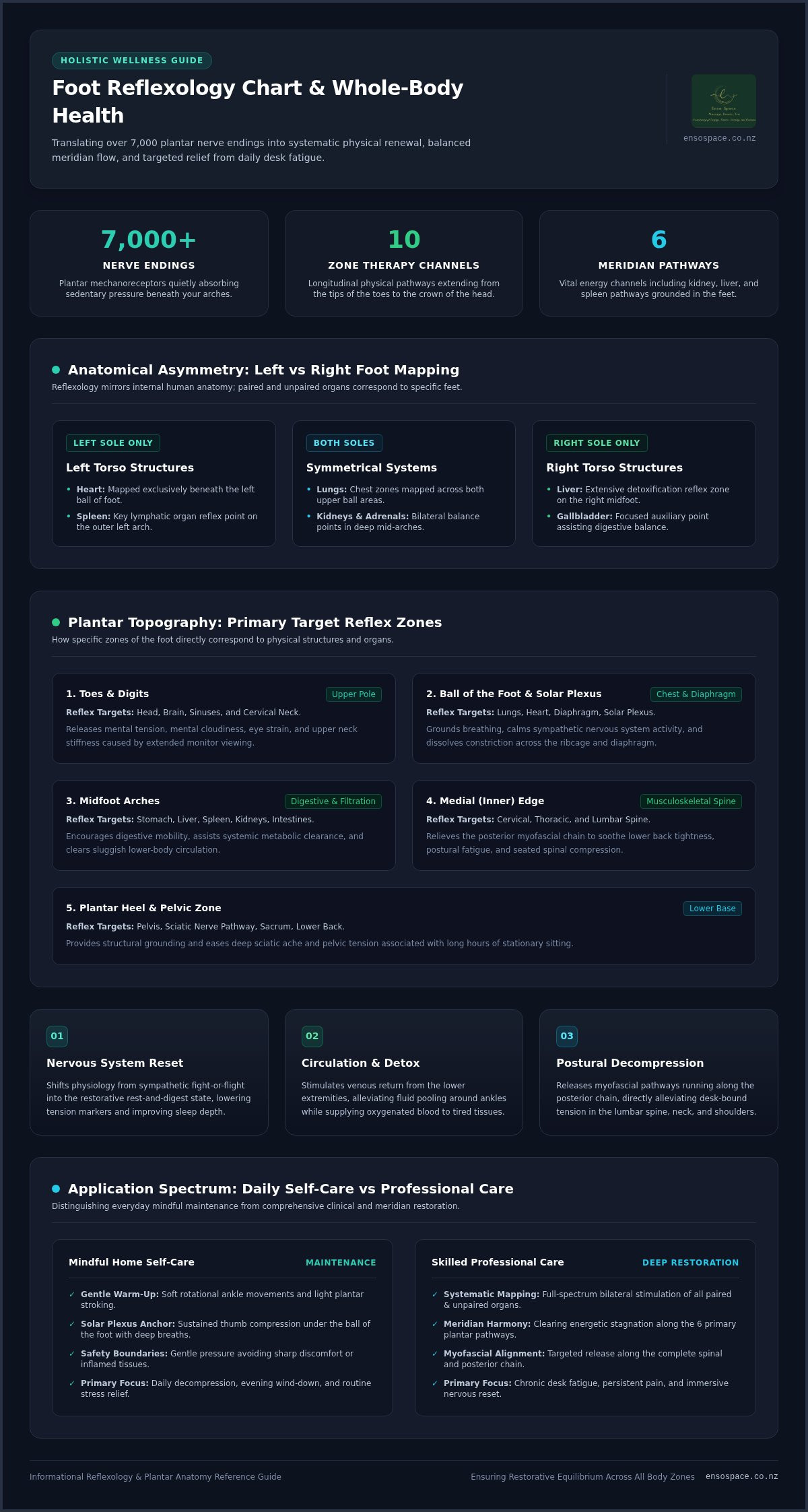
Your feet do not present identical maps. Rather, they mirror the natural asymmetry of your internal anatomy:
- The left foot: Directly reflects organs nestled on the left side of your torso, most notably the heart and spleen.
- The right foot: Corresponds to your right side, carrying the exclusive reflex points for the liver and gallbladder.
- Paired organs: Symmetrical systems, including the lungs, kidneys, and adrenal glands, reveal corresponding reflex zones across both feet.
Tending to one foot while ignoring the other leaves your sensory feedback incomplete. Working both feet systematically unlocks the full spectrum of foot reflexology chart benefits, restoring whole-body equilibrium from heel to toe.
Key Foot Reflexology Chart Benefits for Whole-Body Health
Tension softens when touch is deliberate. Genuine foot reflexology chart benefits reach far deeper than temporary comfort for tired soles; they offer a reliable doorway to whole-body renewal. By systematically stimulating mapped reflex zones, you send rhythmic sensory messages through the peripheral nerves, prompting your nervous system to shift out of sympathetic fight-or-flight into the restorative rest-and-digest state. Breathing slows. Restless thoughts settle. Over time, this conscious stimulation nurtures deeper, uninterrupted sleep and renews your vitality.
Calming the Nervous System and Melting Daily Stress
Targeting the solar plexus point, resting just beneath the ball of the foot, serves as a natural anchor for inner quiet. Sustained, mindful pressure here releases tight constriction across the diaphragm and encourages full, grounding breaths. Clinical research shows that tactile stimulation of plantar mechanoreceptors significantly eases fatigue and nervous strain. This intentional touch creates an immediate sanctuary of mental stillness, signalling the brain to lower stress responses and welcome emotional ease.
Boosting Circulation and Supporting Natural Detoxification
Sedentary office routines often leave fluid pooling around the ankles and lower legs. Firm, rhythmic movements along the midfoot arches promote healthy venous return, delivering fresh oxygen and cellular nutrition to fatigued muscle fibres while assisting the body's natural metabolic clearance. To cultivate complete fluid lightness, many people explore how foot stimulation complements a gentle lymphatic drainage massage for complete systemic balance.
Easing Musculoskeletal Discomfort from Sedentary Lifestyles
Plantar tissues connect directly to the posterior chain through expansive myofascial pathways. Compressing the medial edge of the foot, which corresponds directly to the cervical, thoracic, and lumbar spine, gently eases the stubborn postural aches caused by prolonged screen time. When chronic desk fatigue locks tension into your lower back and shoulders, experiencing focused care at a restorative wellness sanctuary offers the intentional hands-on release your body needs to reset naturally.
Navigating the Foot Chart: Primary Reflex Points and Target Zones
Your foot mirrors your body. Stand tall in your mind, and you can see how the contours of the sole trace the human frame from head to base. The toes represent your highest thoughts and senses, the arch cradles your digestive core, and the heel anchors your pelvis to the earth. In Eastern philosophy, this layout aligns with the downward descent of grounding energy. Understanding this physical alignment allows you to unlock practical foot reflexology chart benefits, transforming an abstract diagram into an intuitive roadmap for daily relief.
The Toes and Ball: Calming the Mind and Chest
Clarity begins above. The fleshy pads of your big toes correspond directly to the head, brain, and pituitary gland. Working the undersides of the great toes gently clears mental chatter, offering welcome solace from screen-induced eye fatigue and tension headaches. The smaller toes shelter reflex points linked to the sinuses, ears, and sensory alertness.
Just below the toe joints, the broad, padded metatarsal area governs your cardiopulmonary centre:
- The left ball: Corresponds to the physical heart and surrounding chest cavity.
- Both metatarsal pads: Shelter extensive bronchial and lung reflex zones.
- The upper groove: Aligns with the throat and neck transit points.
Applying slow, rolling thumb pressure across these pads releases emotional constriction across the ribcage, inviting steady, expansive breaths.
The Arch and Heel: Balancing Digestion and Structural Stability
Digestion demands calm. The medial instep arch, curving inward away from the ground, mirrors your gastrointestinal tract. Kneading the upper arch stimulates reflexes for the stomach, pancreas, and liver, unravelling the subtle digestive stagnation often brought on by sedentary office hours. Moving lower along the central instep eases intestinal tension, supporting a softer, more comfortable internal rhythm.
Reaching the foundation, the dense heel pad connects with your lower spine, pelvic floor, and sciatic nerve. Desk workers who spend hours seated frequently accumulate stagnant pressure here. Firm circular compressions across the heel boundary relieve structural compression in the lower back, restoring a grounded sense of physical ease.
How to Practise Safe Foot Reflexology Techniques at Home
Set an intention to slow down. Practising at home does not require elaborate tools, but it demands your presence. Sit in a comfortable, supportive armchair where your spine rests naturally and your breath flows without restriction. Warm the tissues first. Roll each ankle slowly through its full radius, glide both palms across the dorsal and plantar surfaces with sweeping strokes, and work a dab of natural jojoba or camellia oil into tight ligaments. Warming the skin awakens dormant nerve endings, ensuring you reap genuine foot reflexology chart benefits before applying deeper pressure.
Mastering the Thumb-Walking Technique and Pressure Levels
Precision relies on steady leverage rather than brute force. Bend the first joint of your thumb slightly, resting the fleshy pad against the targeted reflex zone. Move forward in small, incremental steps like a tiny caterpillar, pressing inward, rolling over the tip, and resetting without lifting entirely from the skin.
- Calibrate your sensation: Seek a dull, satisfying ache that invites release; sharp or shooting pain indicates excessive force.
- Sustain the hold: When you discover a tender micro-knot, pause for three to five breaths while maintaining gentle, static contact.
- Maintain linear order: Progress systematically from the tips of the toes downward toward the heel pad to mirror natural energetic descent.
Mindful Precautions, Contraindications, and Hydration
Respect physical boundaries. Sip a cup of warm water or herbal infusion immediately after completing your routine; hydration aids the circulatory system in flushing mobilized metabolic residue. Never press into inflamed, broken skin, acute fungal flare-ups, or unhealed bone fractures. Those managing deep vein thrombosis, acute phlebitis, or peripheral neuropathy with reduced tactile sensation should consult their medical doctor before exploring home reflex work.
Nurturing your feet at home offers reliable daily maintenance, but personal reach has its mechanical limits. When tight muscles resist self-applied pressure, you can book a restorative foot reflexology session to experience the deep, uninterrupted release delivered by master practitioners.
Deepening Your Restoration: Professional Reflexology at Enso Space
Home care builds your daily foundation. Yet, true somatic restoration often asks for something deeper: the experienced hands of an attuned practitioner in a space designed purely for rest. Self-massage carries inherent physical tension because your own muscles must remain engaged to apply leverage. In our tranquil sanctuary at 17 Remuera Road in Newmarket, Auckland, you simply recline, breathe, and surrender the weight of your day. Our therapists possess the refined tactile sensitivity needed to identify subtle micro-crystals, dense fascial adhesions, and stagnant meridian blocks that self-treatment cannot fully address. In this immersive environment, the theoretical foot reflexology chart benefits you explore at home transform into profound, felt reality.
The Enso Experience: Combining Acupressure, Meridian Care, and Tea
At Enso Space, bodywork follows an integrated philosophy designed to help you Feel Better, Move Better, and Live Better. Our specialised therapists blend targeted foot reflexology with time-honoured traditions, grounding every stroke in Eastern healing arts. Discover our holistic approach to traditional Chinese wellness in Auckland to witness how complementary therapies restore natural equilibrium.
For individuals seeking whole-body alignment, pairing lower-limb reflex points with our signature Chinese meridian massage clears energy bottlenecks along the spine and torso. Following your treatment, we invite you to sit quietly with a traditional tea ceremony experience. Sipping warm, artisanal tea prolongs parasympathetic relaxation, allowing the restorative effects of your therapy to settle deeply into your nervous system.
Investing in Long-Term Vitality with an Enso Wellness Membership
Lasting balance requires steady rhythm rather than occasional rescue. To make preventative wellness an effortless part of modern living, we offer our annual Wellness Membership for NZD 200 per year. Designed thoughtfully for corporate professionals, active runners, and mindful local residents, this structure establishes a sustainable cadence of care.
- Dedicated value: Access exclusive member pricing on therapeutic services throughout the entire year.
- Seamless scheduling: Enjoy priority booking privileges to secure preferred treatment hours around your busy routine.
- Celebratory perks: Receive bespoke birthday rewards and priority invitations to exclusive wellness workshops and seasonal tea tastings.
Committing to consistent care protects your physical energy and mental clarity, ensuring your journey toward whole-body balance remains steady throughout every season.
Embracing Your Path to Whole-Body Stillness
Listening to the quiet signals beneath your feet changes how you carry daily fatigue. Grounded in both ancient meridian wisdom and modern neural mapping, understanding foot reflexology chart benefits reveals how intentional plantar touch soothes an overstretched nervous system, eases restricted circulation, and releases stubborn lower back tension. While mindful home routines offer helpful daily maintenance, your soles often hold deeper layers of stress that ask for dedicated, hands-on care.
When demanding desk routines leave you physically depleted, leave online guides behind and step into our tranquil sanctuary at 17 Remuera Road, Newmarket. Here, specialised therapists blend restorative Eastern reflexology with acupressure techniques and traditional post-treatment tea rituals. With our structured NZD 200 annual Wellness Membership, prioritising whole-body health becomes an effortless, ongoing habit rather than an afterthought. Reserve your restorative foot reflexology session today, and grant yourself the time, space, and stillness to truly thrive.
Frequently Asked Questions
What is the difference between a standard foot massage and reflexology?
A standard foot massage focuses primarily on loosening tight muscles, easing localized joint stiffness, and soothing surface tissues in the feet. Reflexology works through an intentional anatomical map, targeting precise micro-zones linked via neural pathways and meridian channels to distant organs and bodily systems. While both modalities feel profoundly relaxing, reflexology intentionally stimulates systemic equilibrium and nervous system regulation across your entire body.
Can studying a foot reflexology chart cure chronic illnesses or medical conditions?
No. Reflexology is a supportive, complementary wellness therapy rather than a medical cure or diagnostic tool. Exploring foot reflexology chart benefits helps down-regulate chronic stress, improve circulation, and soothe musculoskeletal fatigue, which naturally supports your overall vitality. It works best alongside conventional healthcare rather than replacing professional clinical diagnosis, physical therapy, or prescribed medical treatment from your doctor.
How often should I practise foot reflexology to experience noticeable benefits?
Gentle home routines lasting five to ten minutes, practised three to four times a week, provide wonderful daily maintenance for tired feet and calm sleep. For deeper systemic restoration, scheduling professional care once or twice a month sustains nervous system balance and prevents fatigue from accumulating. Consistency is vital; regular, mindful pressure keeps circulation moving and prevents tension from settling into your lower limbs.
Why do certain points on my foot feel tender or gritty during treatment?
Tender or gritty textures beneath the skin typically reflect localized fascial tension, minor metabolic waste build-up, or stagnant flow along specific meridian pathways. In traditional bodywork, these subtle crystalline sensations indicate zones where physical strain has gathered. Applying steady, patient compression disperses these tight adhesions over time, restoring smooth micro-circulation and physical lightness without requiring sharp or painful force.
Is foot reflexology safe to receive during pregnancy?
Reflexology offers gentle relief for fluid retention and fatigue, but skilled caution is vital during pregnancy. Specific reflex zones around the inner and outer ankle, as well as the heel, correspond to pelvic circulation and reproductive reflexes in meridian theory. Always consult your obstetrician or midwife before booking, and ensure your therapist is experienced in modifying techniques for maternal care.
What should I expect during a professional foot reflexology appointment at Enso Space?
At our Newmarket sanctuary in Auckland, your experience begins in a quiet, warmly lit room away from urban commotion. After discussing your personal wellness needs, our therapists use rhythmic acupressure along targeted reflex zones to unlock genuine foot reflexology chart benefits. We conclude your session with a peaceful traditional tea ceremony, giving you time to absorb the stillness and depart feeling restored.


